 ASPNetWorld
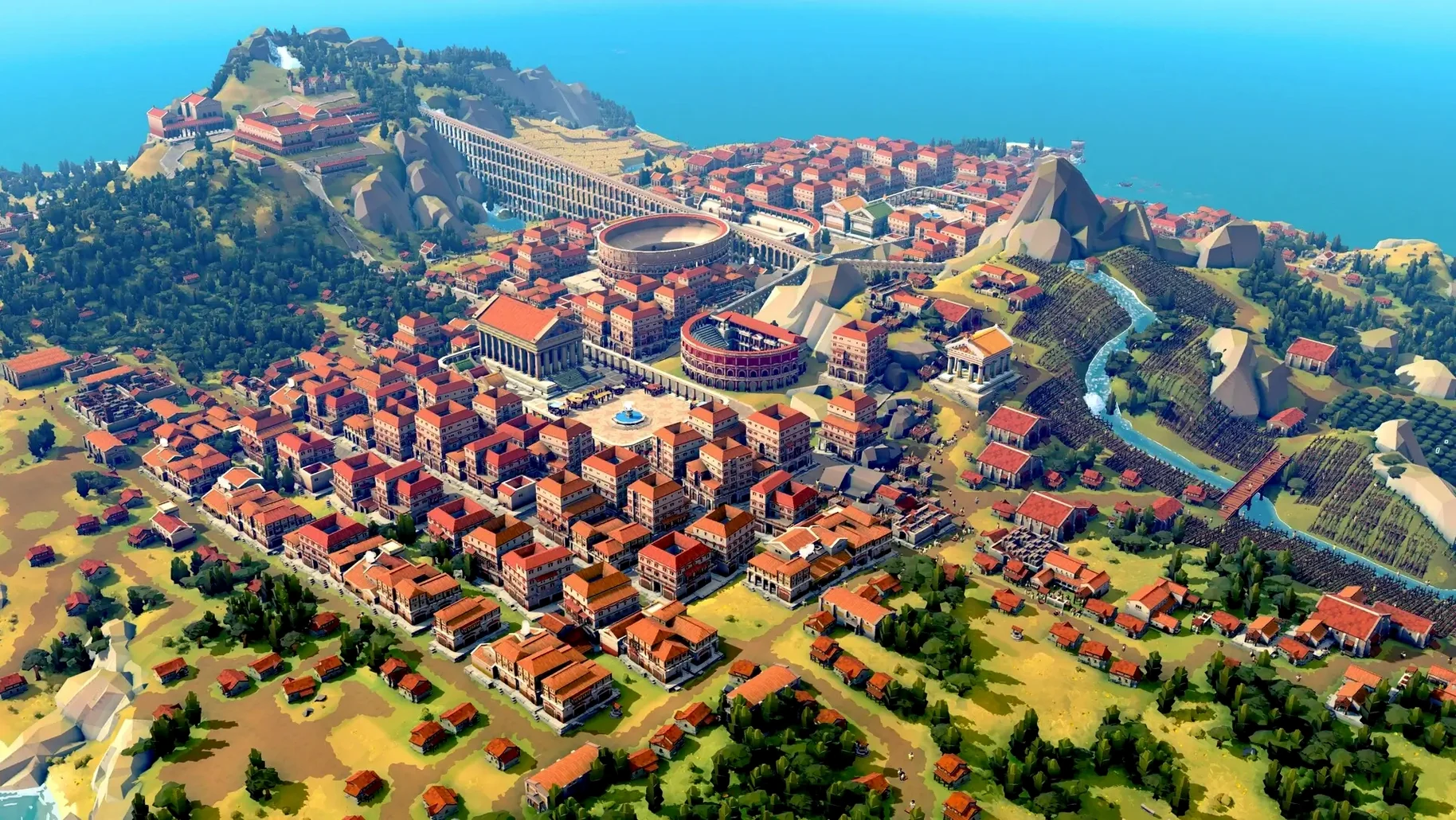
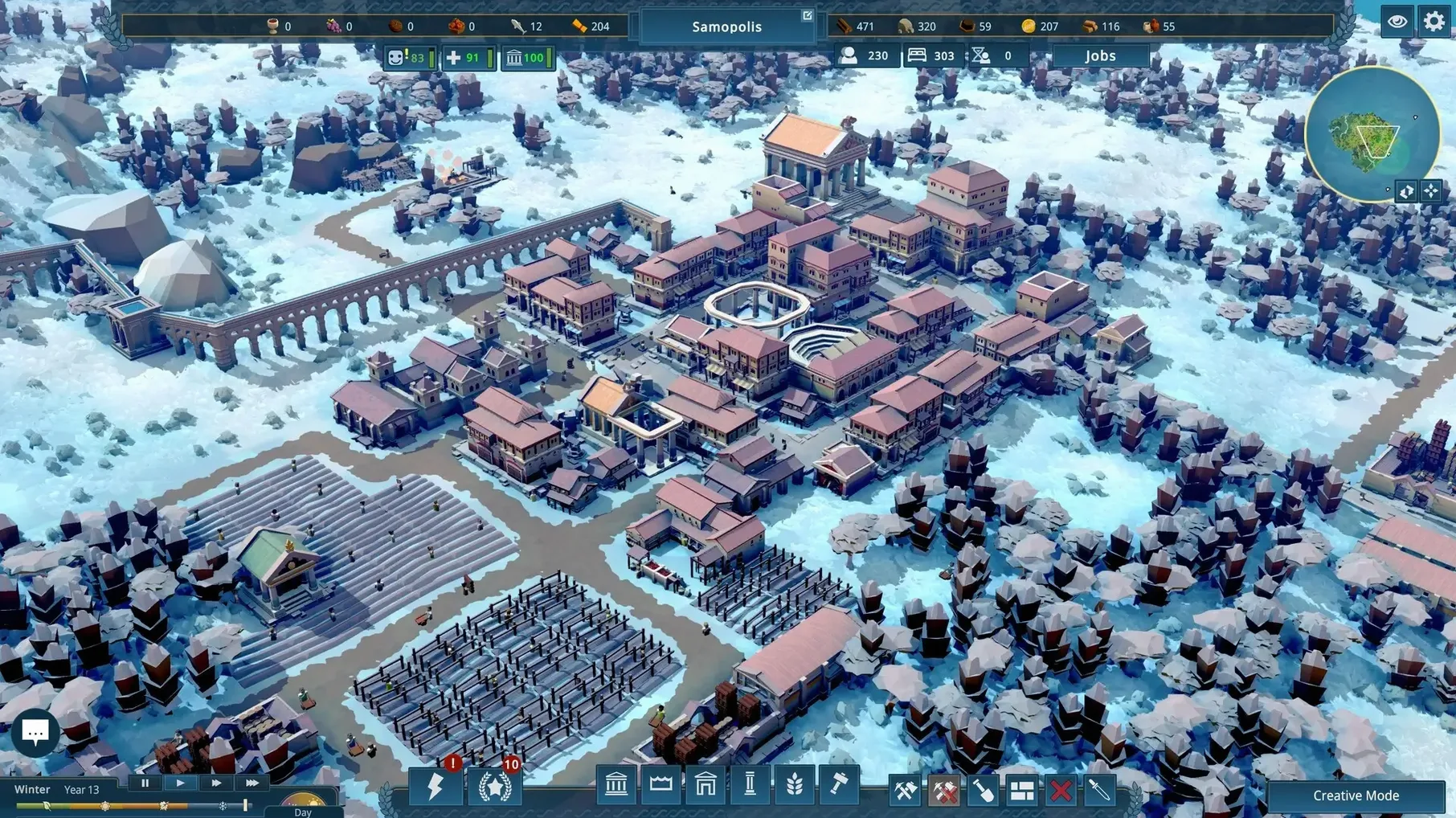
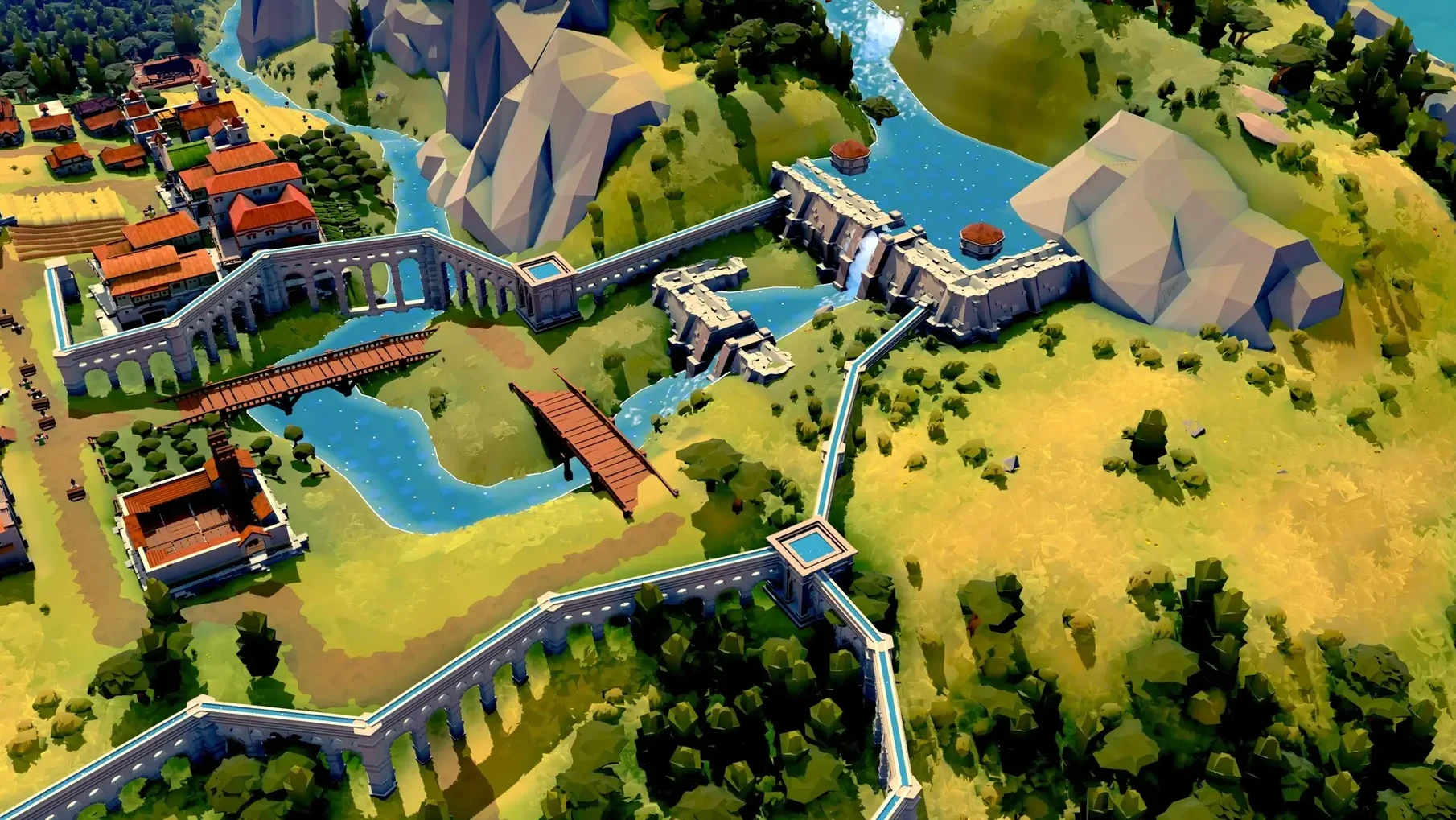
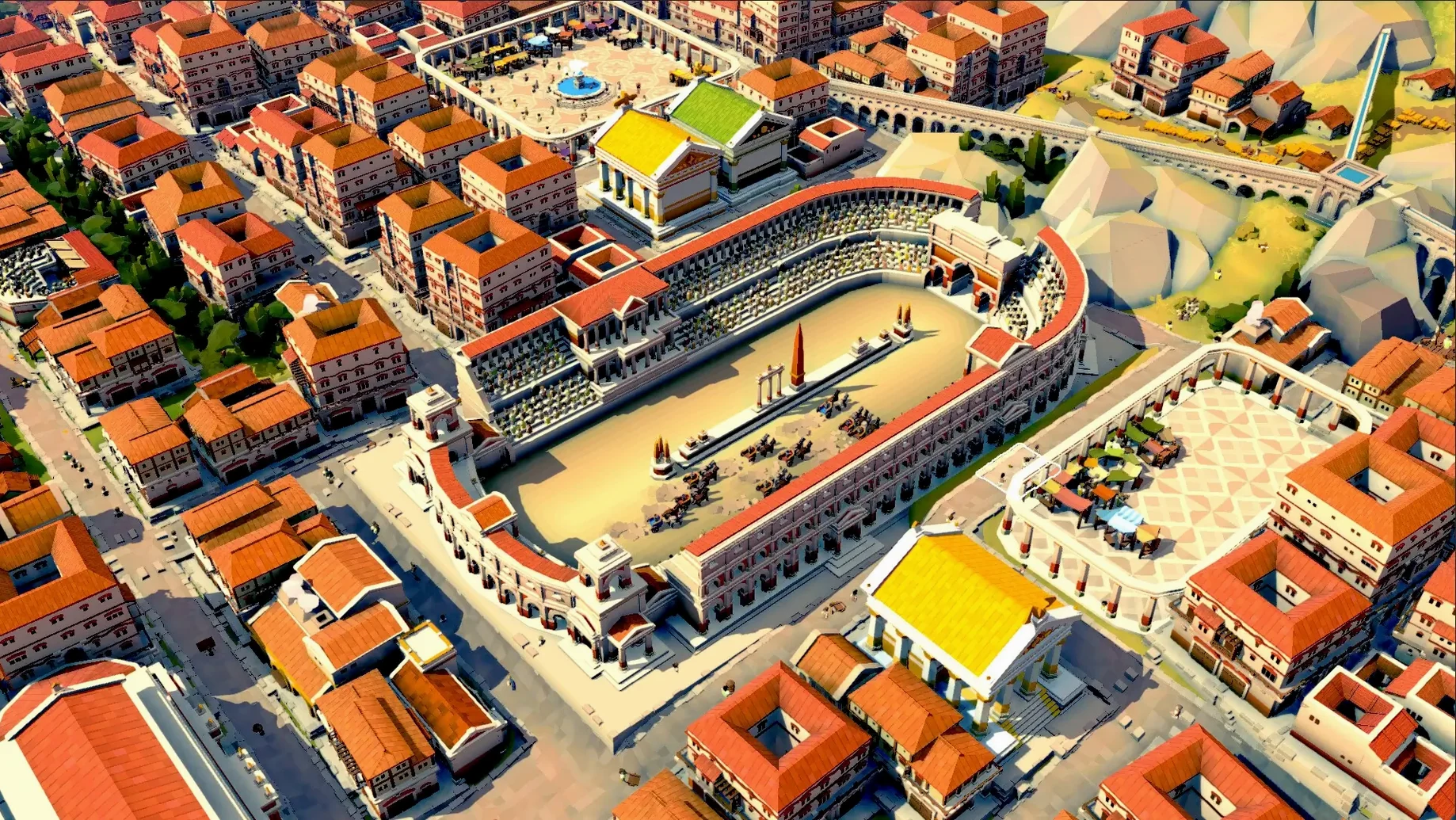
Nova Roma is a city-building game where you guide a small band of settlers as they turn an empty patch of the ancient world into a functioning Roman city, balancing the earthly demands of taxation and supply chains against the need to keep the gods on your side.
Running Nova Roma on a Mac
The developer has tested the macOS build on both Apple Silicon and 64-bit Intel architecture, so the game runs natively on modern Macs without Rosetta overhead on M-series chips. Performance expectations are firmly in mid-range territory — if your Mac can handle a detailed 3D city-builder with weather effects and water simulation, it will feel at home here. The landscape isn't just decorative; the game models hydrodynamics, so aqueducts and farms behave differently depending on the lay of the land and the weather rolling in. Controls follow the conventions you'd expect for a management sim on Mac, with plenty of clicking, panning and zooming as you lay out forums, temples and trade routes.
What you actually manage
Beyond the usual zoning and road-laying, Nova Roma layers on systems that push it closer to a societal sandbox. You develop supply chains to meet your citizens' rising expectations, levy taxes to fund public works, and research technologies that open up new building options. The divine favour system means you will be building temples — not just for the architectural splendour, but because neglected gods have a habit of expressing their displeasure through your city's misfortune. It is a game about nudging dozens of interlocking plates in the right direction, with music setting the mood but no spoken dialogue to lean on.
Water pressure ignores flat pipes and fights gravity
One of the first things that trips people up is water pressure. The aqueduct system models head pressure, not just connectivity, so a reservoir placed on low ground will struggle to feed fountains uphill even if the pipes look fine on the overlay. Open the water map and check the flow direction arrows — blue means it is pushing, grey means it has stalled. A quick fix is to drop a small header tank on higher terrain and run a short spur from it, rather than trying to force everything from one low-level source.
Another headache is divine wrath stacking up without an obvious cause. The game does not always telegraph which god is annoyed until the lightning starts hitting your granary. If you see the favour bar dipping and cannot work out why, check whether you have recently expanded a district that encroaches on a sacred grove or built a noisy workshop next to a temple precinct. Gods have zoning preferences, and the tooltip on a temple's placement panel tells you what it wants to be near — and far from.
Supply chain logjams at granaries are the third big gotcha. Citizens collect food from the nearest granary, not the one with the most stock. If one end of your city is starving while another has overflowing stores, try restricting which goods each granary accepts via its inventory panel, or build a small market stall as a buffer. The cart-pushers will redistribute more sensibly when they have a mid-point to aim for.
A citizen portrait reveals the gladiator school's real bottleneck
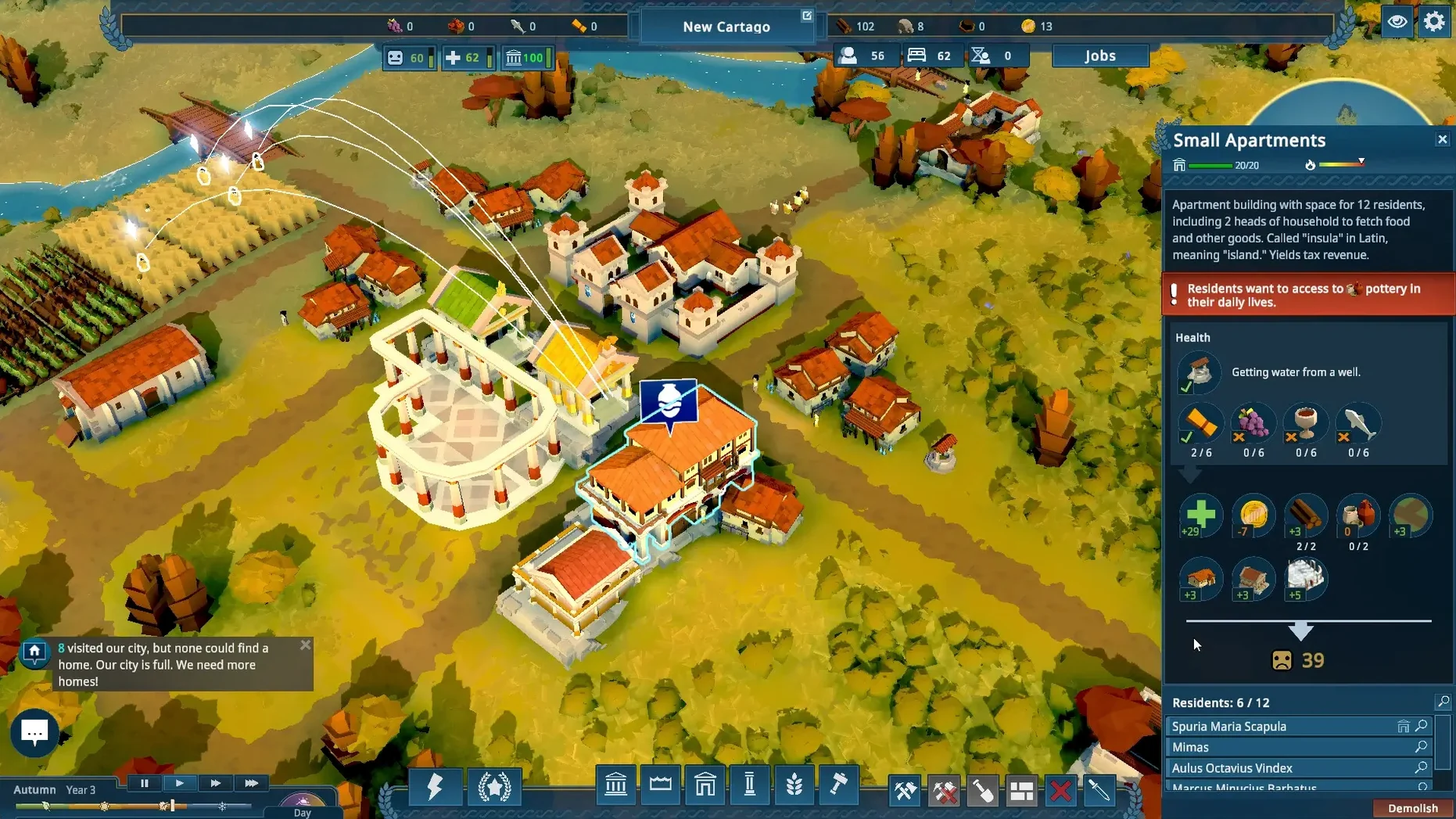
Double-clicking any citizen opens a portrait panel that tracks not just their needs but their daily route and current task. It is the fastest way to diagnose why your gladiator school has no trainees — the likely answer is that your hopeful recruits are stuck walking halfway across the map for a loaf of bread that a nearer bakery could provide.
The game has a subtle overlay toggle bound to the F3 key that cycles through desirability, water pressure, and divine favour heatmaps without opening the full menu. Holding Shift while placing a road locks it to the cardinal directions, which stops the wobbly pathing that looks organic but confuses the block-placement AI. And if you are tired of hunting for that one idle worker among two hundred citizens, the citizens list panel has a filter drop-down tucked in its top-right corner — sort by profession and the idlers float to the top.
Win conditions dissolve into a living model you prod and watch
Set against something like Pharaoh: A New Era, Nova Roma feels less like a mission-driven puzzle and more like a living model you prod and watch. Pharaoh gives you clear win conditions and a structured campaign; Nova Roma leaves you to decide what a successful city looks like, and the systems — divine favour, water physics, lawmaking — push back in ways that feel less scripted. The trade-off is that Nova Roma does not yet have the narrative scaffolding to match Pharaoh's mission variety, though it is still in active development.
Compared with Farthest Frontier, Nova Roma leans harder into societal management and softer into survival mechanics. Farthest Frontier has raiders, crop blight, and harsh winters that can wipe a settlement if you are careless. Nova Roma has weather and landscape that matter, but the real threat is internal: an unbalanced economy, a neglected temple, a law that sounded sensible but turns your citizens against each other. It is a slower burn, and the lack of combat may feel like a gap if you come from a survival city-builder background.
Next to Anno 1800 — which runs well on Mac via native ports — Nova Roma is deliberately smaller in scope. Anno is about production chains sprawling across multiple islands and trade-route optimisation on a grand scale. Nova Roma keeps your focus on a single settlement, but the depth comes from how the systems interlock rather than from geographic sprawl. The water simulation alone gives it a tactile quality that Anno's abstracted fertility scores do not match. If you enjoy the early-game feel of Anno, where every warehouse matters, Nova Roma stretches that phase into the whole experience.
A scenario: the cautious governor
Imagine someone who plays city-builders less for optimisation and more for the feeling of a place growing under their care — the sort of player who names their bakeries and feels guilty when a citizen's happiness dips. In Nova Roma, they settle a river bend with a gentle slope, lay out a small forum, and build a temple to Ceres before even thinking about taxation. The first law they pass is a grain dole, because they have read their Roman history and know a hungry crowd is a dangerous one. An aqueduct proves tricky — the only viable spring sits behind a hill — so they spend an hour tweaking the gradient, adding a header tank, and finally watching the fountain sputter to life. By the time they train their first troupe of actors and see citizens gathering in the theatre instead of grumbling in the forum, the city feels earned rather than engineered. That quiet satisfaction — the sense that the place works because of small, deliberate choices — is exactly the register Nova Roma plays in best.
- Runs on both Apple Silicon and 64-bit Intel Macs
Questions I keep hearing
Does Nova Roma have spoken languages or voice acting?
No, the game includes music but has no spoken languages listed; all communication with your citizens and the gods is text-based.
What interface languages does the Mac version support?
The interface is available in over a dozen languages including English, French, German, Japanese, Simplified Chinese and several others.
Do I need to worry about the gods in this game?
Yes, appeasing the gods is a core mechanic — you build temples to keep them happy, and neglecting them can bring consequences down on your settlement.
Questions from the class 0
Sign in or join the class to ask a question.
Nobody has asked anything yet. If you have used it on a real job, say what the file did.
Also on the Games shelf
The whole Games shelf Oceanhorn 3: Legend of the Shadow Sea
Sets you loose across a flooded fantasy kingdom to sail, dive, and battle colossal mechanical Titans.
Oceanhorn 3: Legend of the Shadow Sea
Sets you loose across a flooded fantasy kingdom to sail, dive, and battle colossal mechanical Titans.
 Old World
Mixes turn-based empire management with unfolding family dramas and a dynastic line you must protect.
Old World
Mixes turn-based empire management with unfolding family dramas and a dynastic line you must protect.
 No Man’s Sky
Explores an endless galaxy, landing on planets without a loading screen.
No Man’s Sky
Explores an endless galaxy, landing on planets without a loading screen.
 No, I'm Not a Human
Forces you to decide which desperate strangers to let into your shelter during an apocalypse.
No, I'm Not a Human
Forces you to decide which desperate strangers to let into your shelter during an apocalypse.
 Oxygen Not Included
Models the thermodynamics, plumbing and morale of an asteroid colony that digs too deep.
Oxygen Not Included
Models the thermodynamics, plumbing and morale of an asteroid colony that digs too deep.
 NBA 2K26 Arcade Edition
Lets you command an NBA team through a full season of five-on-five basketball.
NBA 2K26 Arcade Edition
Lets you command an NBA team through a full season of five-on-five basketball.
 Palworld
Sets you loose in an open world to build, fight and ranch bizarre creatures alongside friends.
Palworld
Sets you loose in an open world to build, fight and ranch bizarre creatures alongside friends.
 NBA 2K25 Arcade Edition
Lets you play full five-on-five basketball with official NBA teams and a career mode.
NBA 2K25 Arcade Edition
Lets you play full five-on-five basketball with official NBA teams and a career mode.