 ASPNetWorld
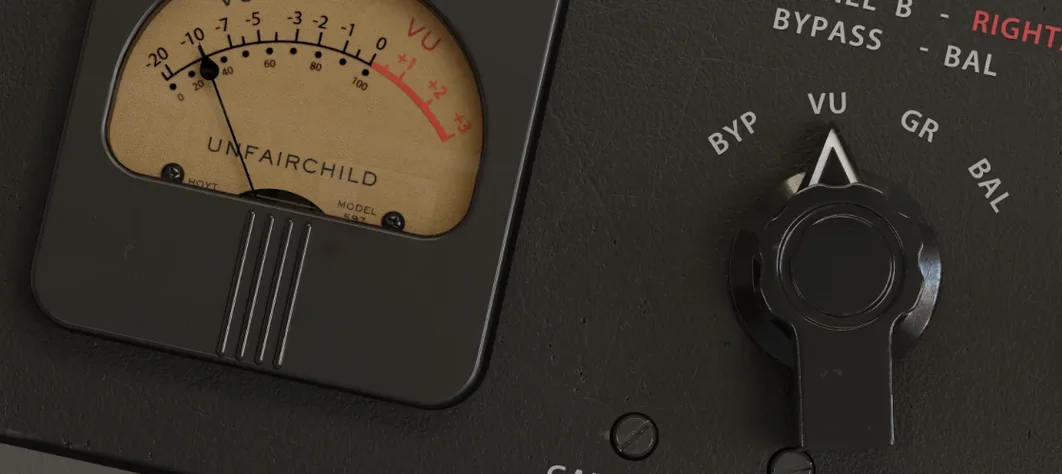
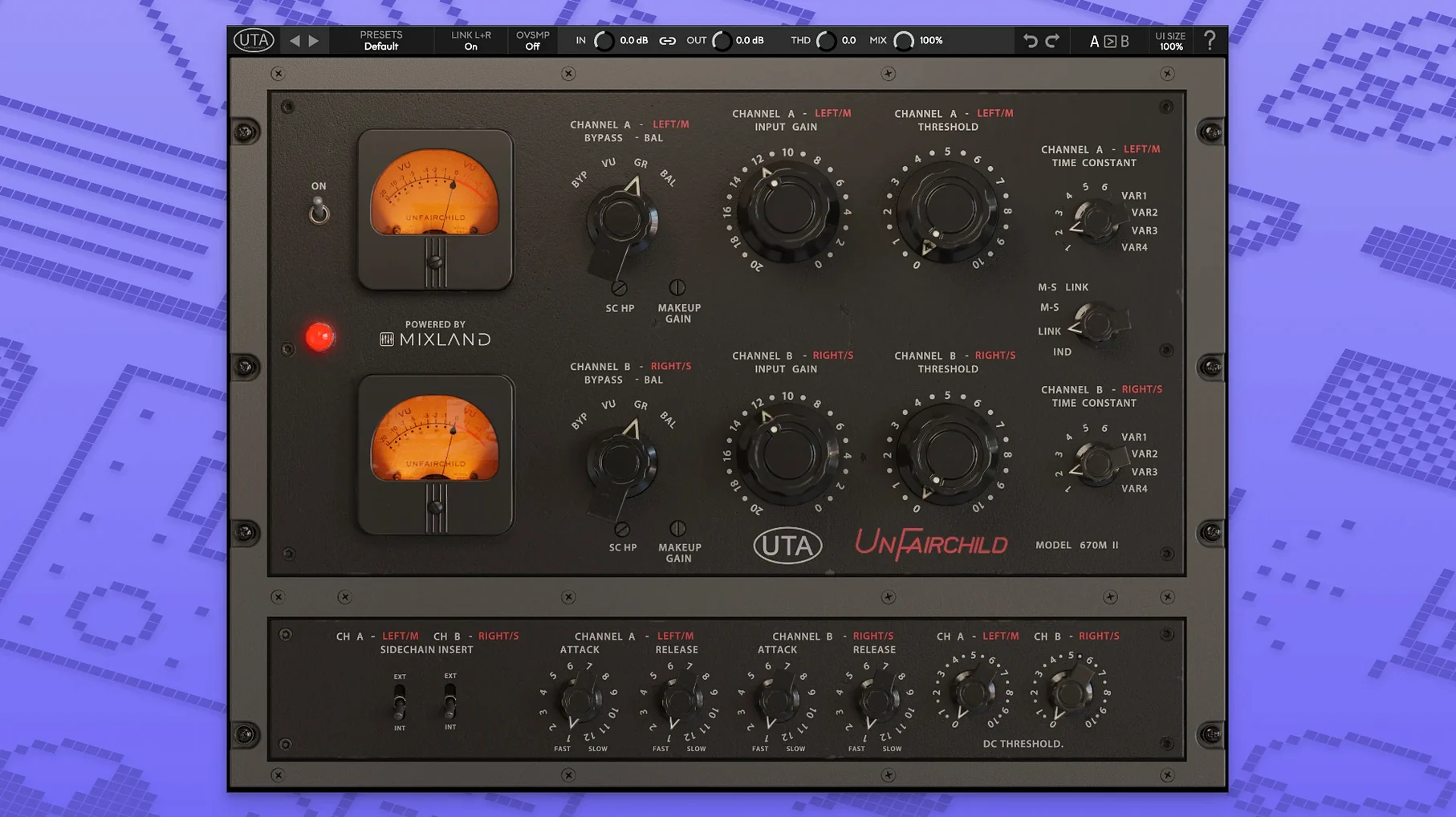
The THD control is often where a mix finds its glue. Rather than a simple on/off switch, this dial lets you season the harmonic saturation independently of the gain reduction, so you can drive the valves into a warm, rounded breakup while the needle barely moves.
Drum bus crush
Slung across a drum group, the feed-back mode does what vari-mu circuits have always done best: it breathes with the rhythm. The attack and release aren't carved in milliseconds on a screen — they follow the programme, tightening up on dense fills and relaxing into the decay of a room mic. A couple of dB of reduction and a nudge of THD turns a polite kit into something that sounds like it was tracked to tape in a very expensive room.
Stereo mix massage
Engage the MS function and the UnFairchild becomes a mastering engineer's secret. You can leave the mid channel open and dynamic while squeezing the sides just enough to stop the stereo image spilling out of the speakers. The link between channels stays musical because the detector circuit, developed in collaboration with MIXLAND and Eric Valentine, reads the whole picture rather than clamping down on one rogue transient.
Parallel punch on bass
Feed-forward compression gives you a faster, more predictable envelope, and on a bass DI it's a revelation. Blend the crushed signal back in with the dry, and the low end thickens without losing the articulation of the fingers on the strings. The side chain filter keeps the compressor from overreacting to subby flab, so the gain reduction rides the midrange body of the note instead.
Valve modelling doesn't send your CPU through the roof
The most common one is about the valve modelling and CPU load. People hear "painstaking recreation of a vari-mu circuit" and picture their laptop fan taking off. In practice, the UnFairchild sits in the same ballpark as the MIXLAND Tilt or a good tape emulation — perfectly happy on a handful of busses in a busy session, though you wouldn't slap one on every single channel. The ARM-native build helps on Apple Silicon machines; on an M-series Mac, a stereo instance barely registers above idle.
Another question concerns the DC Threshold control, a feature you don't see on every compressor plugin. It adjusts the point at which the side chain starts reacting, effectively shifting the knee of the compressor without altering the ratio. Think of it as a way to decide whether the circuit grabs the body of the sound or just its peaks. On a vocal that wavers between chest and head voice, a slight DC Threshold tweak keeps the compression even across the range rather than clamping down only when the singer belts.
People also ask whether the plugin needs a separate iLok dongle. The activation is handled entirely in software, so once the package contents are followed, the UnFairchild authorises locally and stays out of the way. No dongle, no cloud session to drop mid-mix.
Envelope personality versus a diode-bridge compressor
Put the UnFairchild next to something like the Arturia Comp DIODE-609, and the difference is in the envelope personality. The Arturia unit leans into the grabby, fast-recovery character of a diode-bridge design, which can be brilliant on snare snap but less flattering across a full mix. The UnFairchild, by contrast, rounds off transients with a tube-driven softness that feels more like a console's built-in compression than an outboard insert.
Compared with the Klanghelm MJUC, a plugin many engineers reach for when they want vari-mu colour on a budget, the UnFairchild offers finer control over the time constants and a more detailed harmonic structure. The MJUC's strength is its simplicity — three models, a handful of knobs — while the UnFairchild gives you six original preset time constants, four variable ones, and independent choices between feed-back and feed-forward topologies. That extra control means you can dial in a slower, more pillowy release for a ballad and then switch to a tighter, more modern grip for a pop chorus without changing plugins.
The UAD Fairchild collection obviously shares DNA, but the UnFairchild plugin isn't simply a software port of a vintage circuit. The 670M mkII hardware it models was redesigned from the ground up by UnderTone Audio, and the plugin collaboration with MIXLAND and Eric Valentine built the code to match that specific machine. The THD control alone gives it a different flavour, letting you add valve saturation before or after compression in a way the UAD emulations don't expose so directly.
Turning a clean, flat kit into roughed-up drums late at night
Picture a late-night mix session. The drums sound clean but emotionally flat — a well-recorded kit that never got roughed up on the way in. You insert the UnFairchild on the drum bus, set the time constant to the second preset slot, and switch the topology to feed-back. The meter starts dancing with the kick and snare, pulling back maybe three decibels on the loudest hits.
You open the THD control to about ten o'clock. Immediately the cymbals gain a silvery smear, and the snare wire rattle feels less separate from the shell — like the whole kit is breathing the same air. The toms, which previously poked out of the stereo field, now sit inside a cohesive pocket. You toggle true bypass on and off a few times, and each time the processed signal feels less like a plugin and more like a memory of a drum room you never actually booked.
Next you engage the MS function and pull the side gain down by a couple of decibels. The overheads, which were spilling wide and distracting from the vocal, tuck in neatly toward the centre. The kick stays anchored in the middle, unaffected, because the mid channel compression remains gentle. You've now shaped the stereo width and the dynamic envelope with a single plugin, and the CPU meter hasn't budged beyond a polite nod.
- macOS 10.13 or later
- Apple Silicon or Intel processor
- VST, AU or AAX host
Questions I keep hearing
Does the UnFairchild plugin work on Apple Silicon?
Yes, it supports ARM and 64-bit x86 architectures, so it runs natively on Apple Silicon and Intel Macs from macOS 10.13 onwards.
What's the difference between feed-back and feed-forward modes?
Feed-back mode uses the output signal to control compression, giving that classic, program-dependent vari-mu feel. Feed-forward reads the input, offering a tighter, more predictable response.
Can I use it on individual tracks as well as the mix bus?
Absolutely. It's designed to sit anywhere in a session, from drum and bass groups to the full stereo mix, and the side chain processing keeps it controlled on individual sources.
Questions from the class 0
Sign in or join the class to ask a question.
Nobody has asked anything yet. If you have used it on a real job, say what the file did.
Also on the VST Plugins shelf
The whole VST Plugins shelf Ultra Audio Ultra
Puts a wavetable synthesiser with simple controls onto your instrument track.
Ultra Audio Ultra
Puts a wavetable synthesiser with simple controls onto your instrument track.
 UJAM Symphonic Elements STRIIIINGS
Blends orchestral strings with processed textures for cues that breathe and move.
UJAM Symphonic Elements STRIIIINGS
Blends orchestral strings with processed textures for cues that breathe and move.
 Valhalla DSP Bundle
Offers nine plugins of reverb, delay, and modulation built on deep acoustic models.
Valhalla DSP Bundle
Offers nine plugins of reverb, delay, and modulation built on deep acoustic models.
 uJAM Cinedream
Layers ambient guitar textures that sit beneath a scene rather than stepping into the spotlight.
uJAM Cinedream
Layers ambient guitar textures that sit beneath a scene rather than stepping into the spotlight.
 UJAM Beatmaker VICE
Supplies the crisp, gated drum sounds of 1980s synthwave and retrowave productions.
UJAM Beatmaker VICE
Supplies the crisp, gated drum sounds of 1980s synthwave and retrowave productions.
 VocalNet
Morphs a lead vocal with breathy samples to create an airier double without a second take.
VocalNet
Morphs a lead vocal with breathy samples to create an airier double without a second take.
 VocalSynth 2
Thickens a vocal with vocoder and polyvox layers while keeping its core identity intact.
VocalSynth 2
Thickens a vocal with vocoder and polyvox layers while keeping its core identity intact.
 WaveLab Pro
Provides a dedicated mastering workspace with sample-accurate editing and analysis tools.
WaveLab Pro
Provides a dedicated mastering workspace with sample-accurate editing and analysis tools.