 ASPNetWorld
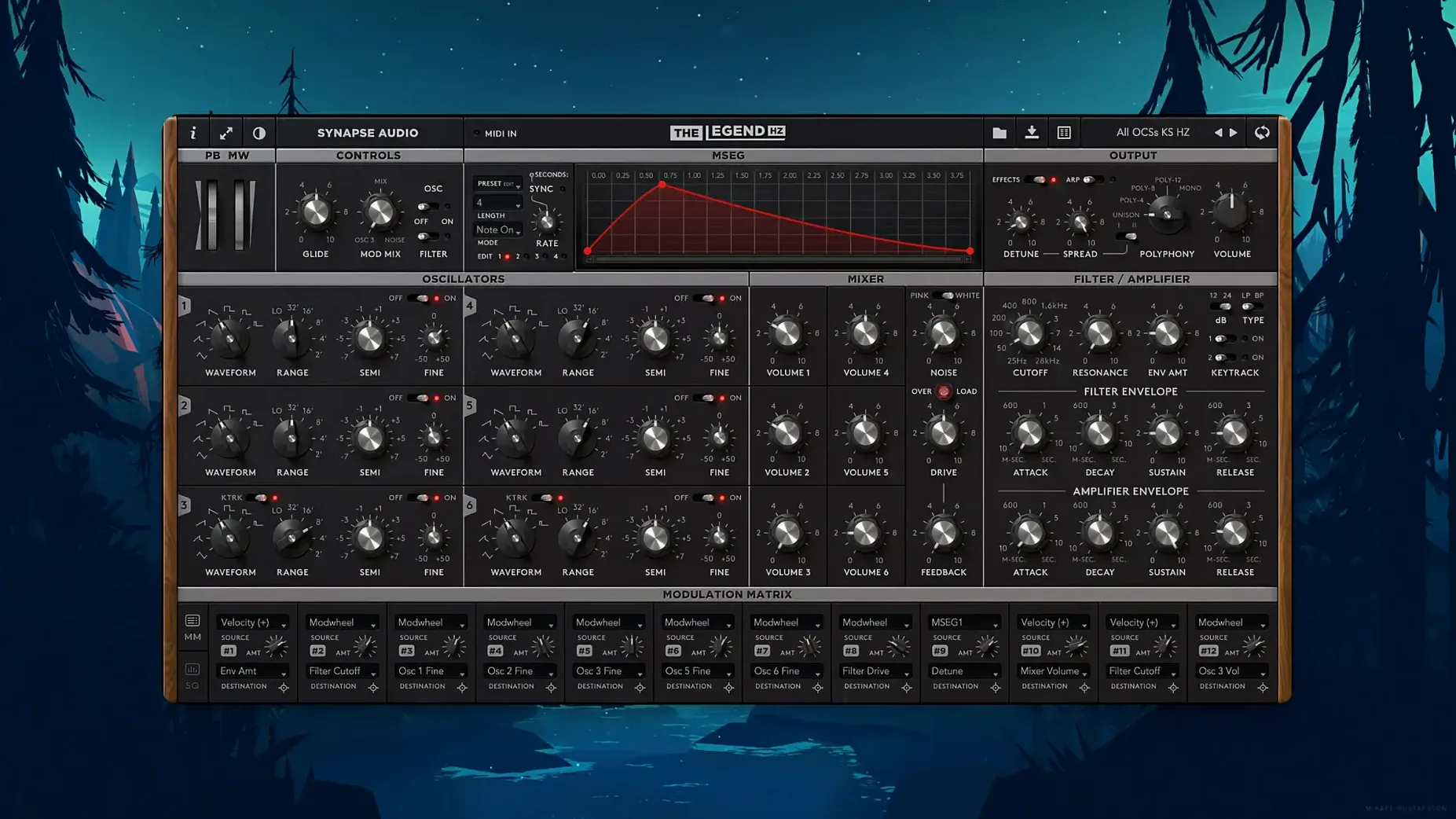
If you know The Legend, you already recognise the warmth of a well-modelled Minimoog-style signal path. The Legend HZ takes that familiar oscillator-and-ladder-filter core and places it in a wider production context, with extra routing that makes sense the moment you start slotting it into a session. It feels less like a replacement and more like an expanded console channel for a classic monosynth, giving you the same immediate bass and lead tones but with broader sweet spots when you process them further down the chain.
Punchy sub and creamy leads that cut through without a fight
Drop it onto a software instrument track and it behaves like a hardware synth patched straight into your desk. The 200 factory presets cover punchy sub bass, creamy legato leads and percussive plucks that sit neatly in a dense arrangement. Because the voice architecture stretches to 12-note polyphony, you can also push it into pad territory without losing the discrete, per-voice drift that keeps the sound alive. On a bus, a little low-end from The Legend HZ can anchor a whole drum group, especially now that version 2.1 adds compressor saturation—a gentle thickening that glues the transient without obvious squashing. It works across VST, AAX and Audio Unit hosts, so the same patch can travel from a writing template to a final mix session without translation quirks.
Working alongside the original
One practical detail that makes a difference in a busy project: old sessions that contain The Legend load the original instrument automatically, so you can run both side by side. That means you can reach for the HZ edition when you need the extra back-panel EQ or MTS-ESP microtuning without breaking recall on older work. Patches and soundbanks travel both ways too—anything you built in The Legend opens here, and the new Kevin Schroeder factory set gives you fifty starting points shaped for the updated toolset. On Apple Silicon or Intel Macs running macOS 10.14 and later, it slots in as a straightforward, musician-friendly workhorse that respects the lineage while quietly adding what modern sessions actually need.
Six oscillators and cinematic presets make film scoring feel immediate
Film and game composers tend to bond with The Legend HZ quickly, partly because the Hans Zimmer connection is more than a name on the tin—the factory presets lean into cinematic weight and movement, and the six oscillators plus the 914 Fixed Filter Bank make it easy to shape a cue’s emotional temperature without stacking half a dozen plug-ins. Sound designers get a similar lift: the unison mode spread across twelve voices can turn a single held note into a textured, evolving bed, and the back-panel EQ added in version 2.1 lets you carve space before the sound ever hits your channel strip.
Keyboard players who favour MPE controllers will also find it a natural fit. Slide between notes on a ROLI Seaboard or a LinnStrument and the engine responds with the kind of per-note pitch and timbre variation that usually demands a much more complex setup. Producers working in electronic, ambient or left-field pop styles often mention how The Legend HZ sits in a mix with less corrective EQ than other analogue models, which means faster decisions when you are building a track from scratch. If you spend more time tweaking oscillators than scrolling through presets, the hands-on layout rewards that habit.
Dip 300 Hz on the back-panel EQ to shed the factory politeness
The factory state is musical, but a handful of adjustments make it feel like your own instrument. First, open the back panel and locate the paragraphic EQ. The default is flat, so even a gentle 2 dB dip around 300 Hz on a bass patch cleans up mud before it reaches your compressor. Switch on the compressor saturation at a low setting—around 9 o’clock on the dial—and you get a subtle transformer-style weight that glues the low end without obvious pumping.
Next, visit the voice allocation section. The Legend HZ defaults to eight voices, which is generous, but if you are playing big chords with long releases, bumping it to twelve prevents note stealing during held passages. For monophonic lead lines, dial it down to one voice and enable legato mode; the envelope retrigger behaviour feels more like a vintage single-voice synth that way. Lastly, check the oscillator drift control. A small increase—barely a few percent—introduces the gentle tuning instability that makes a unison pad breathe, while leaving it at zero keeps basses tight and focused.
Conveniences that slip under the radar
A few workflow shortcuts hide in plain sight. Holding the Shift key while turning any knob gives you fine control, which is invaluable when you are nudging the filter cutoff by a semitone for a resonant peak that tracks the key. Right-clicking a control resets it to its default value instantly—no need to squint at the readout. The arpeggiator doubles as a step sequencer, and you switch between the two modes with a single button; once you have a pattern going, dragging MIDI out of the plug-in window (in hosts that support it) drops the notes straight into your arrangement lane.
The 914 Fixed Filter Bank is easy to overlook because it sits on the back panel, but patching it between the oscillator mixer and the main filter—just a click on the routing matrix—gives you formant-like vowel shapes that transform a simple sawtooth. Another quiet luxury: MTS-ESP microtuning, added in version 2.1. If you work with world music intonations or just want a piano that sits differently against a synth pad, loading a Scala file through MTS-ESP retunes the whole instrument without per-note workarounds.
Typical hiccups and how to smooth them out
One of the first things people notice is high CPU usage with all six oscillators running in twelve-voice unison. The fix is usually straightforward—reduce the voice count in the polyphony settings, or freeze the track once the part is committed. If you are running an older Intel machine and hit slowdowns during a dense cinematic arrangement, switching to a single oscillator with the sub-oscillator engaged still delivers a thick fundamental while keeping the session responsive.
Another common moment of confusion comes when loading a project that used the original Legend. The DAW recalls the original plug-in, not The Legend HZ, which catches people out because they expect the upgraded version to appear. That behaviour is deliberate—it preserves recall accuracy—so if you want the HZ features on an old track, load it manually and copy the patch across using the shared preset format. On the subject of presets, a handful of the Kevin Schroeder additions use the back-panel EQ heavily; if one sounds unexpectedly thin on your system, check that the EQ band gains are not already cutting frequencies you would normally keep flat.
Users who find The Legend HZ through a the legend hz download from a production forum sometimes report that the plug-in does not appear in their DAW after installation. The most reliable fix is to rescan plug-ins from the host’s preferences and confirm that the component, VST and VST3 files landed in the correct folders. Occasionally, a the legend hz mac torrent bundle includes an older version that predates the MTS-ESP support; updating to version 2.1 resolves that and also brings in the compressor saturation circuit. Activation hiccups—where the synth drops into silence after a few minutes—usually trace back to the licence file not being placed in the shared Application Support directory; the included instructions spell out the exact path for both Intel and Apple Silicon Macs.
Version 2.1 opens up the back panel of The Legend HZ with a few quiet but meaningful upgrades. There is a paragraphic equalizer for surgical tone-shaping after the filter stage, plus compressor saturation that thickens the signal without losing the analogue character. MTS-ESP microtuning support is now built in for anyone working outside equal temperament, and Kevin Schroeder has contributed 50 new factory presets that show off the revised feature set.
- macOS 10.14 or later
- Apple Silicon or Intel 64-bit processor
- VST, AAX or Audio Unit host
Questions I keep hearing
Can I load my old Legend patches into The Legend HZ?
Yes, patches and soundbanks made for the original Legend load directly into The Legend HZ, so your custom library carries over.
Does The Legend HZ replace the original plugin in existing projects?
No, it is a separate instrument. Projects that used The Legend will still open that plugin, so both can run in parallel without breaking older sessions.
What is new in version 2.1 of The Legend HZ?
Version 2.1 adds a paragraphic equalizer on the back panel, compressor saturation, MTS-ESP microtuning support and 50 new factory presets by Kevin Schroeder.
Questions from the class 0
Sign in or join the class to ask a question.
Nobody has asked anything yet. If you have used it on a real job, say what the file did.
Also on the VST Plugins shelf
The whole VST Plugins shelf T-RackS
Masters audio with virtual studio gear.
T-RackS
Masters audio with virtual studio gear.
 Supertone Air
Matches re-recorded dialogue to production sound.
Supertone Air
Matches re-recorded dialogue to production sound.
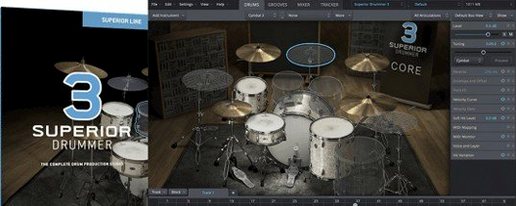 Superior Drummer
Provides realistic, multi-channel drum recordings.
Superior Drummer
Provides realistic, multi-channel drum recordings.
 Steinberg SpectraLayers Pro
Edits audio spectrally and visually.
Steinberg SpectraLayers Pro
Edits audio spectrally and visually.
 SSG Audio Optimus
Masters audio with intelligent spectral assistance.
SSG Audio Optimus
Masters audio with intelligent spectral assistance.
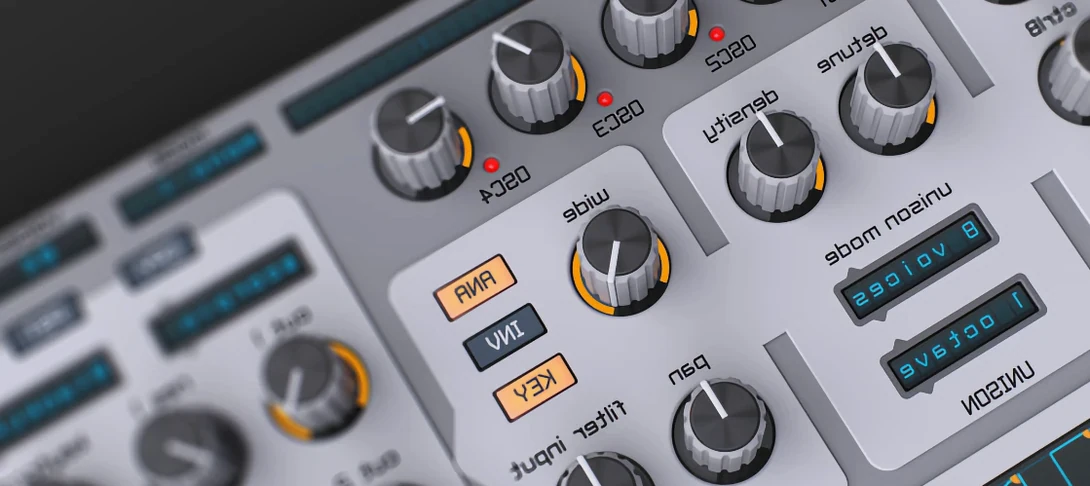 Spire
Synthesises rich virtual analogue sounds.
Spire
Synthesises rich virtual analogue sounds.
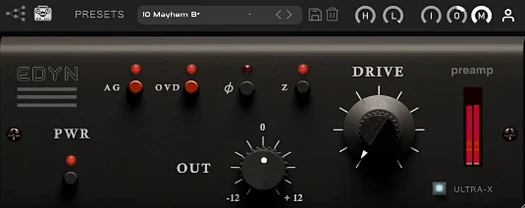 Tone Empire EDYN
Runs clean digital audio through a model of a revered vintage transistor preamp.
Tone Empire EDYN
Runs clean digital audio through a model of a revered vintage transistor preamp.
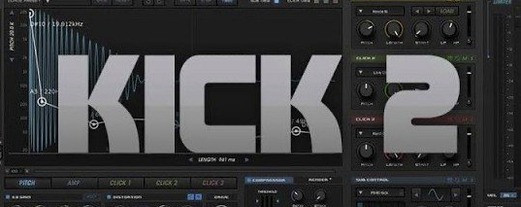 Sonic Academy KICK
Designs a kick drum from a synthesised sub layer and sampled click layers you tune by ear.
Sonic Academy KICK
Designs a kick drum from a synthesised sub layer and sampled click layers you tune by ear.